
News
First female graduate of the BayBatt master's programmes
05.03.2026
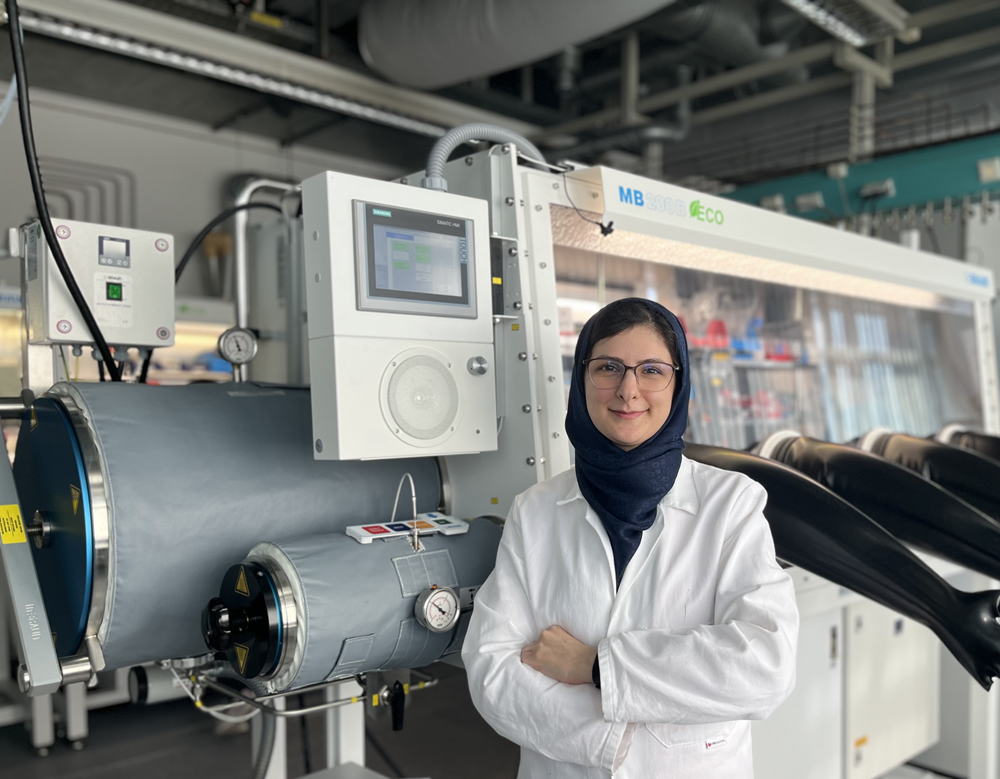
Mahsa Emamjomeh in Prof. Bianchini's lab.
Since their introduction in the winter semester 2022/23, the master’s programmes Battery Materials & Technology and Batterietechnik have celebrated a number of firsts. Now, it is time for another one: the first female graduate!
In September 2025, Mahsa Emamjomeh successfully completed her master’s degree in Battery Materials & Technology. She wrote her master’s thesis at the Chair of Inorganic Active Materials for Electrochemical Energy Storage (Prof. Dr. Matteo Bianchini) on the topic of “Exploring Nickel- and Manganese-based Disordered Rock-Salt (DRX) Cathode Active Materials for Li-ion Batteries”. Mahsa previously completed her Bachelor’s degree in Applied Chemistry at the Sharif-University of Technology in Iran.
At the end of her studies in Bayreuth, we asked her a few questions about her master’s studies:
BayBatt: Why did you choose the University of Bayreuth and the master's programme Battery Materials & Technology?
- Mahsa Emamjomeh: I chose the University of Bayreuth because it offers the right balance between strong academic quality and a welcoming, international atmosphere. With my background in Electrochemistry, I wanted to deepen my knowledge not only scientifically but also from an industrial and practical perspective. The program and BayBatt, with modern laboratories, gave me the opportunity to connect theory with real-world applications and prepared me to contribute meaningfully to the battery field and the energy transition.
What was a highlight of your Master's programme?
- A highlight of my master’s program was my master’s thesis in Prof. Bianchini’s group. It gave me real hands-on experience in experimental research and helped me truly deepen my understanding of battery materials synthesis. Through this experience, I clearly understood how fundamental science connects to real applications in battery technology and energy storage, which made my studies feel much more meaningful and practical.
Which was the most difficult exam in your master’s programme?
- The most difficult exam for me was Signal and Systems. Coming from a different educational system and chemistry background, the engineering content was challenging at first, but this course gave me a strong foundation that was very helpful for later semesters and projects.
What’s next for you?
- It is to continue in academia, where I can further build on my background in electrochemistry, solar cells, and battery technology.
We congratulate Mahsa warmly on the successful completion of her master's degree and wish her all the best for the continuation of her academic career!