
News
BayBatt students participate in TUM Battery Venture Course
25.09.2026
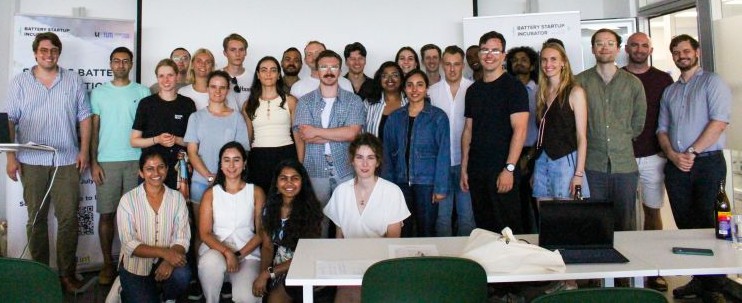
Participants of the Battery Venture course - © TUM Venture Labs
Over the course of the summer semester 2026, the first Battery Venture Course offered by the Technical University of Munich took place in Munich and online. Five master's students from the University of Bayreuth’s Battery Materials and Technology Programme were selected to participate in this project-based program for early-stage researchers, advanced master's and PhD students with the goal to translate cutting-edge battery technologies into market-ready companies. During the course, participants developed commercialization pathways across the battery value chain in multidisciplinary teams. The course was supported by the expertise and network of TUM Venture Labs and the Battery Startup Incubator.
Over 14 sessions, experts from academia, industry, startups, and venture capital guided the seven student teams through the full venture-building journey from battery fundamentals and team building to customer discovery, go-to-market strategy, IP, fundraising, and scaling deep-tech ventures with AI.
The students from Bayreuth worked in three different teams:
- Value of Information in Dispatch (VoID), looking at how smarter battery dispatch can improve the economics and lifetime of grid-scale storage;
- Spanda, an AI-powered bidirectional (V2H/V2G) EV charging startup. Its product, Spanda One, uses an automated system device that turns a parked car into a source of power for the home or the grid;
- CeraLogic, an AI powered tool that helps in material prediction and optimisation for dry coating type electrode development. The aim was for this tool to cut short the development cycle of dry electrodes.
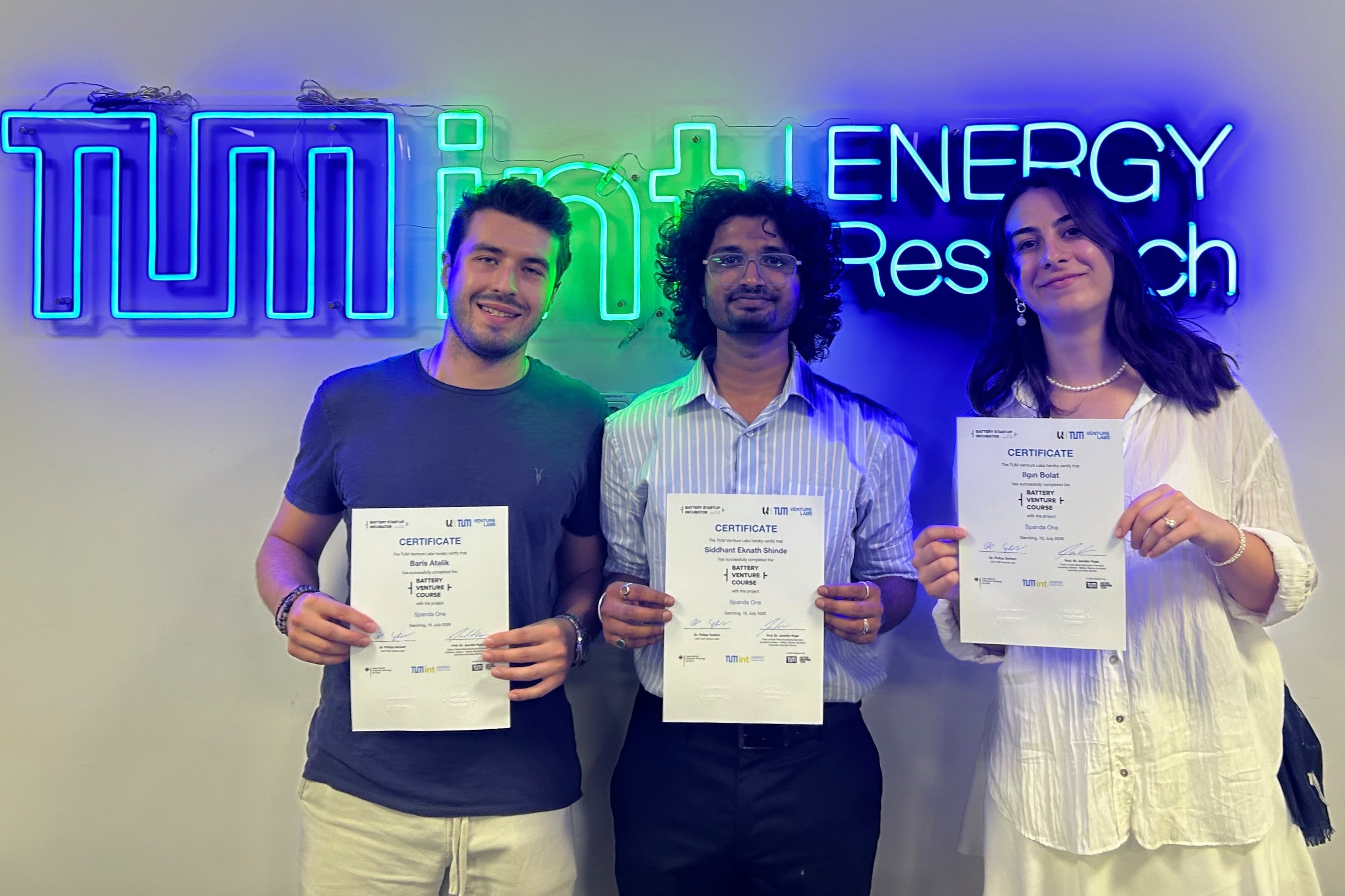
Siddhant (middle) and his team
While they already had the necessary technical expertise, the course taught them important lessons about what it takes to develop an idea into a start-up, and the difference team dynamics make for business development:
Berk relates that "the biggest lesson for me was that an idea on its own is worth almost nothing. Execution is what matters. Along the way we mapped the market, ran stakeholder analysis, and spent real time in customer discovery talking to industry professionals. That's how you find out where an idea actually holds up, where the incentives align, and where the tech is feasible enough to build a real business case around."
Siddhant similarly summarizes his experience: "I learned that ideas only become real the moment you're willing to say them out loud in a room that might reject them. My first-ever startup pitch happened at the course's final pitch session — in front of the full cohort and an audience of Industry experts — and it was rough. But that pitch is the line between "I have an idea" and "I'm building a startup." And Paramvir adds: "The course gave me an insight into building anything systematically, whether it's a product or a complete company. How to think about things and what trade-offs to take care of."
In terms of team dynamics, Berk, who led his Team VoID, says: "I also learned a lot about leading people I didn't know going in. We had our rough patches, but we found a rhythm that worked, and every iteration took the idea a bit further." And Siddhant, who also brought his own idea forward, agrees: "Team dynamics can make or break a project as much as the idea itself."
Looking back, Berk appreciates the overarching idea behind the course: "On a broader level, I think initiatives like this are crucial for Germany right now. Where we can build an edge over global competition is the ecosystem itself: turning the high-quality research coming out of Germany into real ventures, and getting academia, industry, and founders to actually cooperate."
Asked what will happen to his project now that the course is over, Siddhanth shares the steps his idea has taken since: "It's no longer a course project — it's Spanda, my startup, named after the Sanskrit word for the pulse of energy itself. We were accepted into the ETH Zurich Energy Launchpad, one of Europe's more selective early-stage energy programs. I flew to Vienna for ViennaUp, the city's startup festival, where the Energy Launchpad was hosting its opening Events. We have since completed the program's summer School and are now onboarding into TUM's Battery Startup Incubator, finalizing our core team with a technical co-founder search underway, and moving hardware development forward."
For future cohorts of the course, he recommends: "The course is the door, not the destination. If any Bayreuth student is on the fence about applying next year, I would recommend them to apply! What struck me most about the course is that it doesn't matter whether you're an early master's student, a researcher, or a PhD candidate, what matters is if you're willing to convince the right people your idea is worth their time. If you believe in it as much as the market eventually will, courses like this are what actually take an idea from ideation to realization.”
We wish all students the best of luck in bringing their ideas to life and in their future studies!